
In what is becoming an annual event, a spate of bans on the eve of March 8 International Women’s Day has struck numerous WeChat public accounts focused on feminism, women’s rights, LGBTQ+ rights, combatting human trafficking, and promoting mental health, a sign of the continuing stigmatization and silencing of debate about these issues. Many bloggers and commentators have criticized the bans, which formed a glaring contrast to official- and state-media coverage of March 8 International Women’s Day, whose theme this year is "Rights. Justice. Action. For ALL Women and Girls." Some noted that amid the Cyberspace Administration of China’s (CAC) ongoing campaign to “clean up” content purportedly “promoting extreme feminism and inciting gender antagonism,” the red lines seem to be shifting, with even the most cautious and moderate voices now in the firing line.
CDT Chinese editors have compiled a (possibly incomplete) list of recently banned WeChat accounts:
- Free Nora, an independent media outlet focused on countering human trafficking and advancing the rights of people with developmental disabilities or mental illness. (Free Nora also has a Substack account.)
- Ai Daxun, a public-welfare worker who writes about social work, public welfare, women’s rights, and other societal issues.
- Xiaowusheng Psychology, an organization focused on mental health and LGBTQ+ rights.
- Dongxia Primavera, an account that covers feminism and youth issues from a leftist perspective.
- Letters from Two Strange Women, a Gen Z feminist account. (See Substack account here.)
- HerStoryNow, operated by a grassroots feminist group.
- Belonging Space, a team focused on the mental health of women and sexual minorities.
- Exile Land, an account dedicated to improving LGBTQ+ rights. [Chinese]
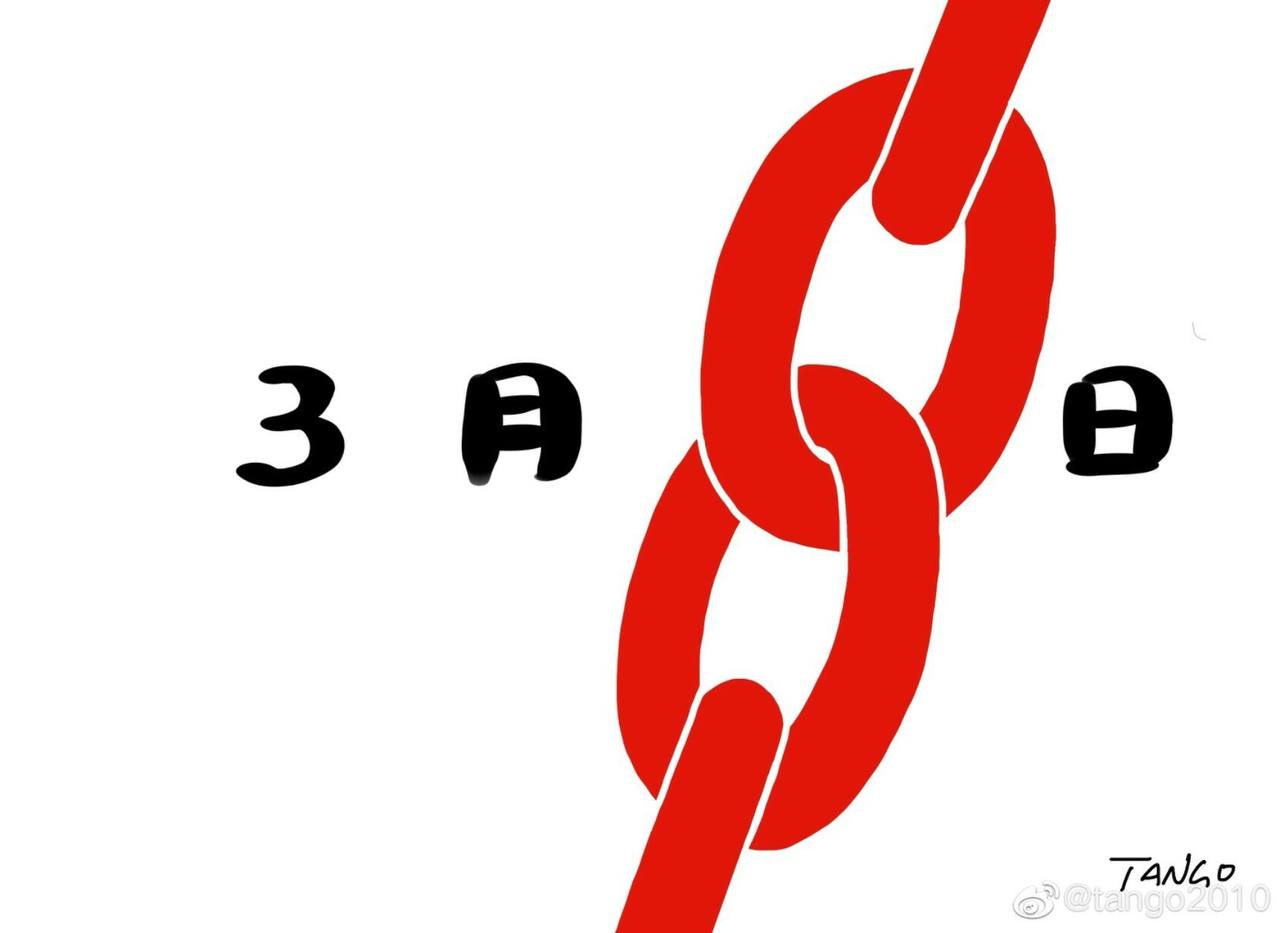
An illustration commemorating 3.8, March 8 International Women’s Day, in which the numeral 8 has been replaced by two links in a chain. The chain is a reference to the case of Xiaohuamei, a trafficked woman who was shackled and chained in a freezing shed by the man who fathered her eight children. (source: Weibo account tango2010)
CDT editors have also archived a farewell letter from Ai Daxun, discussing the closure of her WeChat account and thanking her readers for their support. Ai mentions that she is likely the most moderate of the social-affairs commentators many readers follow, and that despite her best efforts, even she was unable to avoid the red lines of censorship. A portion of Ai’s letter is translated below:
With Women’s Day approaching, I felt that I should post more, and had a lot of content ready to go, but this is such a sensitive period of time, I was afraid that I might go wrong no matter what I published.
My concerns weren’t unfounded. Last year just before Women’s Day, I tried to organize an offline book-club meeting in Guangdong, but just two nights before the event, I got word that it was canceled. I haven’t tried to organize any offline events since then.
[…] But coming back to tonight, I first saw that the Xiaowusheng Psychology WeChat account had been banned. It was the third WeChat account I follow to be shut down within the week. I quickly checked my own account and was relieved to see it was safe. Nervously choosing my words, I wrote something to post on Douban [TikTok’s Chinese counterpart], but I wondered whether it was wise to even express my anxiety at that moment: if some malicious actor read my post and decided to report me, it might backfire. A little while later, I checked the backend again, and realized that I had worried too much: my account was already gone.
As it turns out, the cause of my account ban was a law-related article I’d published last July about the Wuhan University Library [sexual harassment] incident.
[…] Seven months after the fact, my account was “bombed” because of that article. I find it quite baffling, because I’ve had many other articles deleted in the past. Why would they decide to ban me now, over an article that wasn’t even deleted at the time?
[…] At this juncture, I want to point out that I might be the most moderate of the accounts you follow that are still tracking societal events. Sometimes I even avoid expressing my opinions outright, and confine myself to presenting only what I consider to be crucial evidence. Despite this, my account was still shut down. My constant compromises and abundance of caution proved to be futile in the face of ever-encroaching red lines. [Chinese]
As Ai mentions in her farewell letter, the red lines of censorship are increasingly encroaching on social media users’ ability to build community and discuss current events and societal issues. CDT has covered this trend in detail, tracking past “mass censorship events” such as WeChat’s blocking of feminist content in advance of the global women’s summit in Beijing in September 2025; WeChat’s mass deletion of accounts dedicated to gay, trans, asexual, and feminist issues in August 2023, on the eve of the Qixi Festival; and Douban’s large-scale shuttering of feminist accounts in April 2021.
More recently, there has been an increase in online censorship across all platforms of what once would have been considered relatively mild or uncontroversial content. Just two weeks ago, Uyghur comedian Xiao Pa had her Weibo account suspended for this joke, poking fun at the gender imbalance in housework: “I’ve been bedridden for two days with a high fever. Suddenly it hit me that if I had a husband and kids, I’d be clinging to the wall, dragging myself out of bed just to cook for them.” Many Weibo users expressed their dismay at the suspension, with one commenter saying, “What did she write? Let me see … Oh, she just wrote the truth.”
In response to the mass banning of WeChat accounts this Women’s Day, legal blogger Li Yuchen penned a witheringly satirical article heaping “praise” on online censors for their unwavering commitment to “optimizing” the internet. A portion of Li’s pointed article is translated below:
We are grateful to the relevant authorities for “optimizing” the online environment on the eve of Women’s Day.
Two days before Women’s Day, from the evening of March 6 into the early hours of March 7, a group of accounts focused on gender issues were disposed of in short order. Among them were Xiaowusheng Psychology, Ai Daxun, and several other names, none of which we need to remember, since the search engines have been thoughtful enough to help us to forget them.
The entire process involved no announcement, no press release, no disturbance to anyone. This is an exceedingly “mature” form of governance: the problem simply ceases to exist, and there’s no need for alarm.
Nor is this their first rodeo. It would be fair to say that their work, carried out each year in early March, has settled into a stable, even institutionalized rhythm. Other industries ought to take note.
On Women’s Day in 2018, the largest gender-focused account at the time [Feminist Voices, founded by Lü Pin] published “The Ultimate Women’s Day Celebration Guide." The platform [Weibo] responded swiftly, explaining the takedown with admirable clarity: "Content Violation: ‘The Ultimate Women’s Day Celebration Guide.’" The account, which had 180,000 followers on Weibo and 70,000 on WeChat, was wiped out overnight, in a breathtaking feat of efficiency. The account founder later sued the platform, demanding an apology and seeking one yuan in damages. No response was forthcoming.
That the platform would not even bother to respond to a one-yuan claim is ample testament to its staunch and principled refusal to compromise.
[…] Today is March 8, 2026. Marketing campaigns for "Goddess Day" are splashed across all of the major social-media platforms. Merchants are offering special discounts on flowers, lipstick, and skincare products. Media outlets have printed up posters proclaiming: "A salute to each and every remarkable HER." The All-China Women’s Federation has organized symposiums. Everything is proceeding in an orderly fashion.
This is the best possible outcome. In a "clean" online environment, there ought not be too many voices that make people uncomfortable. The accounts that had steadfastly documented the travails of women are gone, but the flowers and lipstick remain.
Happy holiday, and thanks to all the workers who labor so diligently to give us a “wholesome” online environment. [Chinese]