

The sentence after three weeks
You have been writing for three weeks. It is going well. You have talked about music, about work, about last summer. You look forward to every message.
Then the sentence lands. "Children? No, that's not on the cards for me any more."
And you know: that's it. Not because this person is a bad person — but because the two of you don't fit at a point where there is no compromise. Three weeks. And with the next one, the same guessing game starts from scratch.
That is exactly where "That's me" comes in. And the beginning of it takes five minutes.
The first five questions
Here the uncomfortable questions don't come last. They come first.
What age you are looking for. What you want right now. Whether you want children (or more children). How you feel about smoking. How far away the other person may live.
That's it. Five questions, each with ready answers to click. If you know what you are looking for, you are through in five minutes — and from then on your search brief exists. Not some profile that happens to show up, but a person who matches those five answers.
Everything beyond that is voluntary and only makes your result sharper.
Why this isn't an interview
It looks like a conversation, because someone guides you through the questions. But it is not an interview, not a personality test, and nobody is grading you.
It is your form for your matching criteria — on three levels:
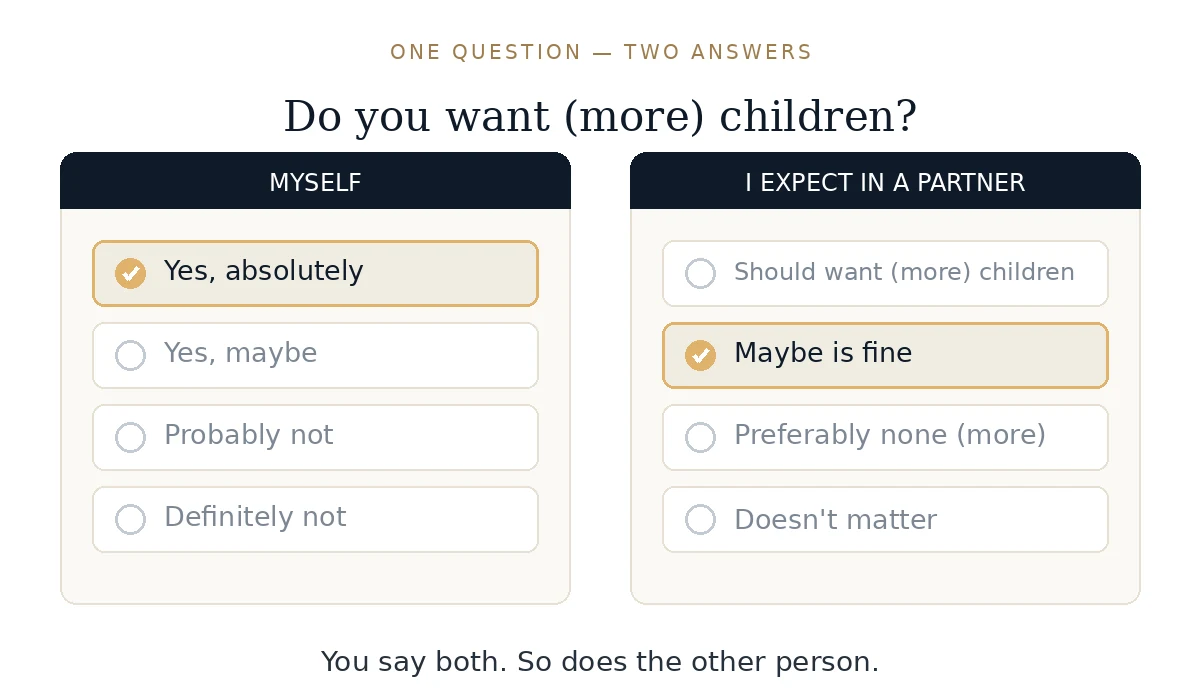
What really counts. Three questions where relationships actually break: who else lives in your home, whether you want children, how you feel about smoking. Here you answer twice: once for yourself, once for what you can live with in the other person. That is what turns a profile card into a search brief.
Important criteria. Fifteen questions about what everyday life together is made of: distance and long-distance relationships, openness to other cultures, education, how active you are, alcohol, diet, pets, where you feel at home, how much closeness you need, how you handle money, faith, political outlook, how you recharge.
Interests and lifestyle. Six questions about what connects: music, travel, free time, sport, films and books, and what you dream of for later. Multiple choice, no pressure, no wrong answer.
You can stop at any time and continue later. What is saved stays saved.
It only works if you tell each other
Take smoking.
If it matters to you that someone doesn't smoke, then say so. And if the other person does smoke — then it is only fair to say that too. Not on the third evening, but before the two of you even start.
Neither of you loses anything by it. Someone who smokes isn't looking for a person who can't stand smoke either. You both save yourselves the same disappointment. It isn't sorting people out — it is a courtesy, in both directions.
And that courtesy is something no one can do for you — not even your tool here. It cannot guess what really matters to you, and it cannot speak for the other person. Only the two of you can let each other know.
That is what these questions are for. It is also why the three most important ones have two columns: "Myself" and "I expect in a partner". You say both. So does the other person. And then you meet — or you don't, but then you know after five minutes instead of after three weeks.
Aren't you curious who guides you through the questions?
Two people ask you the questions — or at least that is what they look like. What Emma and James are is stated openly: AI-generated avatars with synthetic voices. Not real people, not members. How they sound is something you are better off hearing yourself. Pick who should guide you:
Inside the questionnaire one of the two stays with you throughout — you decide at the start which one it should be.
Why avatars at all: a question like "Do you want (more) children — and what can you live with in the other person?" reads harshly when it just sits there as text on a screen. Explained and spoken, it becomes what it is meant to be — a question meant seriously, with no wrong answer.
The explanations are short: usually ten to fifteen seconds, none longer than twenty. If you don't need them, you click on.
Why honesty here is in your own interest
On most platforms you write your profile for other people. You make yourself a little taller, a little sportier, a little more open than you are. Everyone knows this, and it is forgivable.
Here it works differently, and that is the point: your answers are not a public text. They are the basis on which your own suggestions are calculated.
Say you are open to a long-distance relationship without being open to it, and you will get suggestions from half a continent away. Dodge the question about children, and you will be shown people with the same disappointment already built in.
Putting a gloss on things here harms nobody but you. The clearer your answers, the more precisely your tool works for you. Especially with the uncomfortable questions.
The "probably not" folder
Without these details the basis is missing. Your search brief is empty then — and what comes out of that, you probably already know.
It looks like this: all sorts of profiles turn up. You look at them, you puzzle over every single one, wondering whether this could work, you file most of them under "probably not" — and with the next one you start from zero again. Nobody takes that work off your hands. It only exists because nobody said beforehand what should be searched for.
A search brief cannot find anything as long as nobody has written it. That isn't a punishment, that is mechanics.
The arithmetic
Imagine you wanted to find out the same things the usual way. In conversation, with every profile from scratch: children, way of life, closeness, whether moving would be conceivable, how serious it is.
With one person that takes weeks. With ten it is a second job. And the delicate questions don't get asked on the first evening anyway — you feel your way in and notice too late.
You are going to have those conversations regardless. The point is not to avoid them. The point is to have them with someone about whom you know, from the very first message: this person is looking for someone like me.
Answer honestly once, instead of finding out the same thing ten times.
Now
You will find "That's me" in your dashboard.
Your criteria. Your wishes. Your decision about who gets to see them. In the end you are not looking for ten people — you are looking for one.
The first five questions cost you five minutes. Anyone who does all twenty-five steps is finished in twenty to thirty minutes — and that half hour is the best investment of time you can make here. Take your time and answer honestly. It comes back to you with every single suggestion.